How You Know Athena Wisdom in the Odyssey
| Athena | Minerva |
| " | I once warned you, Percy Jackson, that to salve a friend you would destroy the world. Perhaps I was mistaken. You lot seemed to have saved both your friends and the globe. | " |
| –Athena, talking to Percy on Olympus, in The Last Olympian. | ||
Athena, chosen Athene by her closest friends, is the Greek virgin goddess of wisdom, civilisation, mathematics, strategy, defensive warfare, crafts, the arts, and skill. She is oft portrayed as a companion of heroes and is the patron of heroic try. Her Roman counterpart is Minerva.
Contents
- i History
- 1.1 Birth and Accession to the Olympians
- 1.2 Creation of Pandora
- 1.iii Rivalry with Poseidon
- 1.four Life with Pallas
- 1.v Lives of Erikthonius and Daedalus
- ane.half-dozen Inventing the Flute
- 1.seven Coming together Teiresias
- 1.8 Rivalry with Arachne
- 1.9 Olympian Riot
- 1.10 Trojan State of war
- 2 Percy Jackson and the Olympians
- two.1 The Bounding main of Monsters
- two.2 The Titan'southward Curse
- two.3 The Last Olympian
- 3 The Heroes of Olympus
- 3.one The Mark of Athena
- 3.two The House of Hades
- iii.3 The Blood of Olympus
- 4 Demigods & Magicians
- 4.one The Staff of Serapis
- five Magnus Chase and the Gods of Asgard
- 5.ane The Hammer of Thor
- six The Trials of Apollo
- half-dozen.ane The Belfry of Nero
- 7 Personality
- 8 Appearance
- 9 Minerva
- 10 Abilities
- 11 Attributes
- 12 Gifts
- 13 Family
- 13.i Mortal Children
- xiv Relationships
- 14.1 Gods
- 15 Film
- xv.one The Lightning Thief
- xvi Gallery
- 17 Trivia
- 18 Citations
History
Nascency and Accession to the Olympians

Zeus, her father
Athena was born to Zeus and his first married woman, the Titaness Metis. A prophecy had once foretold that Metis would give birth to a daughter so a son who would exist more powerful than his father, which posed a problem as Metis was already pregnant with their first child. To prevent the prophecy from taking identify, Zeus tricked Metis into taking the grade of a fly and swallowed her whole.
However, Metis took the form of intelligence and gave nascency to a girl, who grew inside her male parent'due south head. Over fourth dimension, Zeus began experiencing a terrible headache, and then Hephaestus offered to put Zeus out of his misery by splitting open his head with an awl and hammer. According to Percy Jackson'due south Greek Gods, Zeus commanded Hephaestus to cut open his head and sew it back upward. While nearly of the other Olympians held Zeus down on his throne, Hephaestus created a crack, thick enough for Athena to squeeze her way out, after which she grew into a full-size goddess wearing boxing armor and property a spear, much to the astonishment of the other gods. In some sources, information technology is said that Helios himself stopped in the heaven in astonishment.
Despite the misgivings of the other gods, Zeus insisted that they welcome Athena into their ranks. She officially became ane of the Olympians as the Goddess of Wisdom and Warfare and Queen Hera'south greatest enemy. She taught the Greeks numerous skills essential for their evolution, such equally mathematics, utilizing the oxen to plow their fields, and artisan activities such as weaving.
Despite her being the goddess of warfare, Athena didn't really enjoy combat, but accustomed it every bit an inevitable necessity at times. She was more than focused on minimizing casualties and achieving victory through wise strategies. Through her actions, Athena quickly became Zeus'southward favorite girl and constantly consults her for advice. In The Iliad, Ares in fact accuses Zeus of favoring Athena above the others.
Creation of Pandora
When her father, Zeus, decided to create the irresistible Pandora in social club to punish Epimetheus for his brother, Prometheus', deportment, Athena helped the girl past gifting her with wit and marvel. In addition to that, she taught Pandora how to weave and make crafts of diverse types. This generous human action helped Pandora utilize her time and get rid of boredom.
Rivalry with Poseidon

Athena and Poseidon
For many eons, Athena and Poseidon had a rivalry between them, which can be traced to the time when they competed for the position of patron of the metropolis of Athens, called Attica at that time. The leader of the city asked the ii gods to bestow a gift for the newly constructed metropolis. Poseidon created a salt-water spring, and in another version, and horses, while Athena gave them the olive tree. Seeing that the olive tree was more than useful than the salt-h2o spring and horse for the urban center, its leader Kekrops fabricated Athena their patron goddess. A temple known as the Parthenon was defended to her and the new urban center took the proper name of Athens in her laurels.
The next time which marked a conflict betwixt the 2 Olympians was when Athena responded to the prayers of Coronis, whom Poseidon was trying to seduce. She saved the woman past transforming her into a raven. As a event, a furious Poseidon longed for revenge. Hence, he took his new lover, the priestess Medusa, into a temple of Athena. Furious with Poseidon and Medusa for doing icky acts in her temple, Athena turned Medusa into a hideous animate being who had the additional curse of turning anyone who looked into her irresistible eyes into rock. As Medusa'due south sisters had helped her become inside the temple, they too were transformed. Collectively, the iii sisters became known as the "Three Gorgons." Afterwards receiving Medusa'southward Head as a sacrifice from her one-half-blood brother Perseus, Athena gave the head every bit a souvenir to her father Zeus, who sent it to Hephaestus in order to create the Custodianship. Zeus would trust the shield to his girl from time to time. In The Titan's Curse, Zeus gave the Aegis to Thalia Grace, his daughter, as a gift. However, many sources also claim that the cosmos of Medusa was a approval to her, as she had been Athena's favored priestess, and Poseidon had taken advantage of her within Athena'south temple. Unable to punish Poseidon, Athena instead gave Medusa the ability to plough any man who tried to hurt her once more into stone.
Another fourth dimension both Athena and Poseidon were at odds was well-nigh the affair of the hero Odysseus. While Poseidon was furious with him for blinding his son Polyphemus, Athena favored Odysseus above all other mortals due to his ever using cleverness instead of force and was e'er willing to aid him when he needed it well-nigh. Though it seemed unlikely that Athena and Poseidon would ever cooperate, this did happen when the chariot was invented, every bit she had built the chariot itself and Poseidon had created the horses needed to pull it.
Life with Pallas
Shortly after her emergence from her male parent'due south head, Zeus sent Athena to alive with the nymphs of Lake Tritonis since their warlike nature appealed to her. She would get forth famously with them. Nether their tutelage, Athena would come to become a primary of both armed and hand-to-hand combat. Her dearest friend (or ofttimes seen as girlfriend, without whatever sexual activities), however, was Pallas, the only nymph who could sometimes lucifer her in combat.
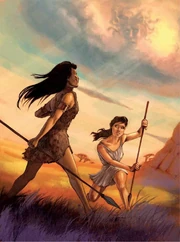
Athena, sparring with the nymph Pallas
One twenty-four hours, the two engaged in a sparring match with such speed and intensity that Zeus, who happened to be watching them at the time, mistook it for a genuine mortal duel. Worried for his daughter'southward safety, he appeared in the sky right backside Athena and held up his fearsome Aegis shield, which greatly unnerved and startled Pallas due to the Head of Medusa on it. Without noticing her father's presence at kickoff, Athena proceeded to disarm her friend of her javelin and counterattacked, stabbing at Pallas's gut. All the same, Pallas was also boring considering she was however going over her stupor, then Athena ended up accidentally fatally piercing her with her sword.
A devastated Athena honored her best friend with a sacred monument, edifice a wooden replica of Pallas and draping a small section of her Aegis cloak over its shoulders. This statue would eventually cease up in the urban center of Troy, becoming known as the Palladium (meaning "Place of Pallas"), where women were immune to claim sanctuary while men were forbidden from even looking at the statue. Since Pallas's statue greatly resembled Athena herself, people would eventually brainstorm referring to the goddess herself as "Pallas Athena," which the goddess encouraged as it helped her keep Pallas'south retention alive.
Lives of Erikthonius and Daedalus
Hephaestus adult strong romantic feelings for Athena because their similar interests in tools and penchant for solving mechanical problems. Unfortunately for him, Athena became one of the Virgin Goddesses and didn't want to ally anyone. However, Hephaestus persistently followed and flirted with Athena until he finally flung himself at her, wrapping his arms around her waist and tearfully burial his face in her brim. In the procedure, some of his divine sweat and tears rubbed off on her bare leg, much to her chagrin. She kicked Hephaestus away, snatched up a piece of cloth to wipe the godly wet off of her, hurled the fabric off Olympus, and ran abroad from her persistent admirer.
Containing the essence of both gods, the fabric would after transform into a mortal babe boy, who Athena found and named Erikthonius. She placed her "son" into a wooden chest, along with a magically conjured serpent, with the intention of his godly qualities eventually being enhanced by the serpent and making him immortal. The snake soon turned into ane of Athena'due south sacred animals, along with the owl and cat. Athena took the chest to the Athenian Acropolis (her most sacred place) and gave it to the daughters of Kekrops while warning them not to open up it. While the princesses agreed, they would be overcome with marvel later only ane night and opened the breast. After seeing Erikthonius and the serpent, the princesses became insane and promptly jumped off the side of the Acropolis' cliffs to their deaths. As the chest was opened, the spell was broken earlier Erikthonius could become immortal and the snake slithered abroad. However, Athena would somewhen take out her vengeance on Kekrops, whom a grown-up Erikthonius would banish and usurp his Athenian throne.
While she remained a virgin goddess, Athena had quite a few demigod children conceived when her divine thoughts met the mortal ingenuity of the men she favored, a love which she believed to be the of the purest kind. Her children are and then born in the same fashion she was, quite literally making them brainchildren. One of Athena'southward most famous demigod children would exist Daedalus. Every bit shown in The Battle of the Labyrinth, she blest both her son and her grandson Perdix. She later punished the jealous Daedalus for killing Perdix by branding him with a partridge, the mark of a murderer. Past doing this, Athena cursed her son to live a long and tortured life.
Inventing the Flute
One twenty-four hours while walking in the woods nigh Athens, Athena discovered a nest of hissing snakes, which gave her a sudden thought for a musical instrument considering of its hissing. She would style it from a hollowed out reed with holes, thereby creating the first flute. Proud of her achievement, Athena took the flute upwards to Mount Olympus, eager to perform in forepart of the other gods. Every bit soon as she started playing, however, Aphrodite, Hera, and Demeter began giggling and whispering to each other. Athena was enraged, and yelled at the goddesses. Demeter and Aphrodite eventually pointed out that Athena's facial features comically contorted while she played.
An embarrassed Athena fled in humiliation and hurled the flute off of Olympus, blasphemous it to give the worst fortune to the next person to play it. Since the flute landed in Asia Modest, that person would end up beingness the satyr Marsyas, who was then stunned by the beautiful music that it created, since it had been filled with Athena's divine breath, that he really challenged Apollo to a music competition. Due to her curse, Marsyas lost and was later on flayed alive by a victorious Apollo.
Coming together Teiresias
1 night, Athena went to a swimming hole in cardinal Greece for relaxation purposes. However, while the naked goddess stood bathing under a waterfall, she heard the cry of a mortal man named Teiresias, who had accidentally come across her. The startled and embarrassed Athena promptly blinded Teiresias. Since he was very atoning, the goddess sent birds and snakes to lead and protect him (granting him the ability to understand their linguistic communication) and gave him supernatural powers of precognition, which atomic number 82 to Teiresias becoming a bang-up prophet presently thereafter.
Rivalry with Arachne

Arachne, her nemesis.
A long time ago, the mortal weaver Arachne challenged Athena to run into who could create the best tapestry. Athena bearded herself as an onetime adult female and tried to warn Arachne that it would be foolishness to challenge a goddess, but Arachne persisted and stated that if she lost, she would accept whatsoever punishment. Enraged, Athena revealed herself and accepted the challenge as she herself had invented weaving. Each of them then made a tapestry: Athena's tapestry was of the gods together in glory and joy while Arachne's showed the gods making fools of themselves, though it was notwithstanding beautiful. While Athena reluctantly admitted the competition was a tie, she was so infuriated by this deliberate insult to the gods that she destroyed the tapestry in rage and mercilessly shell on Arachne.
Nonetheless, Athena became furious when the citizens laughed at her chirapsia up Arachne and turned her wrath against them. Meanwhile, Arachne was filled with guilt and hung herself. Subsequently seeing Arachne'due south body, Athena felt responsible for her death and decided to practise her a favor. She turned Arachne into a spider so that she and all her children would be practiced weavers forever. In other versions of the myth, Athena transformed Arachne into a spider straight after the contest as part of Arachne'due south punishment.
In another version, Athena was chatting with some Ethiopian women, including Arachne, what life was on Mount Olympus, and the women were letting information technology just pass through their heads and forgetting information technology a minute later. But Arachne was the one who sucked it all in. Soon, Arachne boasted about her smashing weaving. Athena, filled with rage, came downwardly from Olympus and challenged her to a weaving competition. In the end, both were equally good, and Athena ripped Arachne's (which was a weaving about how bad the gods were) weaving to shreds, and Arachne, recognizing her wrongs, hung herself from the ceiling, set to drib to her death. Athena was a goddess that gave second chances, and she pitied Arachne, and so consequentially, she became the earth'due south first spider.
Be it whatever reason, e'er since and so, every kid Athena has suffered a deep fear of spiders. They are very paranoid that every spider they see is out to go them and avenge Arachne. Almost of the fourth dimension, this is true every bit spiders are shown to be hostile to them. Arachne'due south proper noun was borrowed into the English language language, and "fright of spiders" became arachnophobia.
Olympian Anarchism
Enraged at her husband'south infidelities and dictatorial means, Hera decided to start a insurrection d'etat and gained back up from other gods, including Poseidon, Apollo, and Athena herself. She provided unbreakable, tightening ropes to assist Hera in her plan. That evening, Apollo, Athena and Poseidon hid in the hall adjacent to the royal chambers, awaiting Hera's signal. As shortly equally Zeus had fallen asleep, all 4 of them quickly bound the King of Olympus with the magical ropes. Fifty-fifty chained up and completely immobilized, an infuriated Zeus looked very intimidating. Poseidon attempted to reason with his brother and demanded that Zeus be a better ruler, just Zeus refused, which prompted Hera to abet leaving him chained upwards in his chambers until he agrees.
Presently thereafter, the iv Olympians departed for the Hall of the Gods for the outset (and last) democratic meeting of the Olympian Council, which proved to be a very cumbersome chore. The violently thrashing and bellowing King of Olympus was found by the Nereid Thetis. Subsequently convincing Zeus to non throw the rioters into Tartarus, Thetis then sought out the assist of the Hekatonkheire Briares, who freed Zeus from Athena'southward magical ropes.
Subsequently, Zeus grabbed his Master Bolt and stormed into the throne room. Later on unleashing his divine wrath upon them, he punished almost all the rebels for their treason. Apollo and Poseidon were temporarily stripped of their godly powers and forced to piece of work as laborers on World for years, while Hera was tied up and suspended on a rope across the Void of Chaos. Soon, Hera was freed by Hephaestus. Fortunately for her, Athena managed to completely evade Zeus's penalization by talking herself out of information technology, equally well as due to their extremely close relationship as father and girl (although it's quite possible Zeus didn't trust Athena every bit much as he used to since he gained a long-lasting distrust for Poseidon and Apollo from the riot and she was the ane who wove the net the rioters used to capture Zeus, but eventually he got over it).
Trojan War
When Eris hurled the Apple tree of Discord into the hymeneals of Peleus and Thetis, bearing the inscription "For the fairest", Athena was i of the candidates who competed for information technology. The Trojan prince Paris was chosen to judge who was the most beautiful of the three goddesses: Hera, Athena, and Aphrodite. Athena offered to brand Paris wiser in battle if he chose her. However, she lost to Aphrodite, for Paris preferred the offering of the beloved goddess.
Furious, Athena took the side of the Greeks in the 10-twelvemonth long Trojan War forth with Hera and Poseidon. She mostly helped Odysseus, whom she finally gave the idea of the Trojan Horse. She too helped the hero Diomedes defeat Ares in a duel. In the course of the war, she cursed Ajax the Lesser with madness.
After Zeus immune the Olympians to directly participate in the war, Athena and Ares engaged in single combat, in which she emerged as the victor and forced her half-brother to flee the battlefield. When Aphrodite attempted to assist her, Athena also defeated her. Athena would later assist Odysseus again multiple times during his long journey back home to Ithaca.
Percy Jackson and the Olympians
The Ocean of Monsters
Athena is seen when her girl, Annabeth, is beingness lured by the Sirens, described as wearing hiking boots and jeans and casual vesture. She was sitting with Luke Castellan and Annabeth's begetter, Dr. Frederick Chase, supposedly at a picnic in the redesigned Manhattan that Annabeth designed.
The Titan'southward Curse
| " | There is always a mode out for those clever plenty to detect it. | " |
| –To Percy Jackson | ||
Athena disguises herself equally a park ranger at the Hoover Dam and advises Percy on how to escape from the Skeleton Warriors (Percy later realized it was her since she had Annabeth's storm-grayness eyes). It is likely that her desire to meet her girl Annabeth saved outweighed her misgivings of him (testifying that Athena truly loves Annabeth). After Percy escapes with Rachel Elizabeth Dare'due south aid, he, Thalia Grace, Zoë Nightshade and Grover Underwood go trapped on the dam, but are saved when the giant metallic affections statues, given to Zeus past Athena, behave them off afterwards Thalia prays to her father.
At the Winter Solstice, when Zeus asks the council if Percy should be left alive as he could be unsafe, Athena, Ares and Dionysus (one-half-heartedly) don't heighten their hands to defend him, merely they were out-ruled by the majority. She afterwards tells Percy not to judge her too harshly and that he is a big risk to take. Percy replies by saying, "So you're maxim you shouldn't have risks?" She concedes to his point, just then informs him of his Fatal Flaw: intense personal loyalty. Percy is understandably outraged by the idea that a desire to help those he loves could exist considered a flaw, just Athena tells him that the most dangerous flaws are those that are skillful nether the right circumstances and that as a hero of a prophecy his flaw could cause the downfall of the world. Percy wants to debate, only is left speechless, thinking "she is pretty darn smart". She leaves after alert him that she does not approve of his relationship with her daughter (based on her rivalry with Poseidon). Upon Annabeth finding Percy with her, Athena moves on and Annabeth realizes that her mother was giving him a difficult time much to her grief.
The Last Olympian
During the Boxing of Manhattan, Athena realizes that Typhon is a distraction that Kronos sent through the United States to get the gods away from Olympus so he could ship his army to overtake information technology. She finally convinces Zeus to transport Hermes to tell the demigods that it is a trap. Through Hermes, Athena tells Annabeth to "Effort Programme 23" and Percy to "Recollect the rivers,". She also reminded him to stay away from her girl, to the anger of both Percy and Annabeth. Despite her help, many demigods from Camp Half-Claret died in the process of defending their parents' thrones.
After the war, Athena tasks Annabeth every bit the designer to rebuild Olympus and praises her girl's abilities in forepart of everyone, making Annabeth very proud. Athena votes for awarding Percy with immortality, though she turns to wait at Annabeth when she says this and most likely noticed her daughter's stricken expression at the thought of losing Percy. Later the council meeting, Athena privately talks to Percy maxim that she could have been wrong nearly him, but not necessarily say she was. She also asked why Percy would give up immortality. He first says that he could not leave Annabeth earlier speedily adds that he couldn't leave his friend Grover either. Athena quickly tells Percy to "spare her" and disappears in a cavalcade of flames that singes his shirt later on alarm Percy she has given him the benefit of the doubt and not to "mess up".
The Heroes of Olympus
The Marking of Athena
While flying to Campsite Jupiter on the Argo II, Annabeth became nervous and wished she could pray to Athena, just that was impossible. She also mentioned a meeting with her mother nigh a month agone, where she was given the worst nowadays of her life from her coming together. The Romans, later conquering the Greeks, decided to crush their rivals by stealing the Athena Parthenos, breaking both their and Athena's spirit. The Romans inverse Athena and reduced her to a goddess of crafts and wisdom, taking away her title as a war goddess and replacing her with other gods like Bellona and Mithras, much to her acrimony. Since her counterpart, Minerva, was a strict maiden, Reyna, Octavian, Terminus, and the other Romans at New Rome were distraught to see her girl Annabeth, calling it scandalous.
While on the Argo Two on the style to Rome, Annabeth recalls her meeting with Athena prior to the first of the journey. Annabeth thought she saw her mother near Sweetness in America where she was studying a map, wishing that Odysseus was in that location to aid her. Annabeth tried to talk to her, but she was in the form of Minerva and had no recollection of Annabeth as her girl. She claimed that the Romans reduced her importance, simply Annabeth states that Athena is non about revenge. As Minerva however, the goddess only seems to crave vengeance for how they disgraced her. When Annabeth asks for help on locating Percy, she says that since Percy has allied with the Romans, he should perish with them and and so she hands Annabeth a coin. She and so tells Annabeth to avenge her and to "follow the mark," before restating she needed to find the way abode.
In Charleston, Aphrodite states that Athena was affected the nearly past the splitting of the Greek and Roman gods, considering she was the almost worshiped Greek god, being the patron of Athens itself. Later, in the lair of Arachne, Annabeth states that Arachne was better than Athena in the weaving of tapestries and starts to doubt her mom's ability as several of Arachne's weavings are better than those of her female parent. After trapping the spider in a Chinese finger-cuff that she got Arachne to weave, Annabeth gloats on how the arachnid had done a bully service to Athena by protecting the Athena Parthenos, but Arachne decides to destroy her lair instead of seeing Annabeth win. Earlier the floor completely caves in, the Argo II blasts a pigsty in the ceiling and saves Annabeth as Arachne fell into the pit to Tartarus. They load the statue of Athena onto the Argo II, just Arachne managed to pull Annabeth and Percy into the pit using her thread that was still fastened to Annabeth.
The House of Hades
Athena appears in Annabeth's dream while she is in Tartarus with Percy, telling her that she has washed well in her quest to retrieve the Athena Parthenos. However, she also tells her that the statue has to exist returned by the Romans at Campsite One-half-Blood, in order to seal the rift betwixt both camps.
The Claret of Olympus
When Reyna fights the behemothic Orion, her sheer bravery greatly impresses Athena, who gives her part of her Aegis for her cloak. The Aegis shields Reyna from a powerful blast and she is stunned when Athena speaks to her to tell her about giving her Custodianship. During Reyna'southward subsequent attack on Orion, she can sense both Athena and Bellona supporting her, though neither appears in person to help. Instead, they requite Reyna the strength she needs to kill Orion on her own. Reyna is able to apply her Custodianship-infused cloak to strangle Orion to decease.
When Reyna, with the help of half-dozen pegasi, finally manages to place the Athena Parthenos on Half-Blood Hill, gilt light ripples across the ground, seeping warmth into the bones of both Greek and Roman demigods and curing all of the Olympians (including Athena) of their separate personalities. As a result, Athena promptly arrives in Athens to participate in the final boxing with the Giants. She is dressed in full Greek battle armor and helps her daughter Annabeth slay Enceladus, after which Hades sends his body back to Tartarus. Athena's sanity is fully restored and no longer afflicted by her vengeful Roman counterpart, Minerva.
Later the Giants' defeat, Athena is seen later rebuking the advancements of Hermes with her fearsome Aegis shield, and gives advice to the Olympian council (giving Jason a glance of approval) when the demigods are trying to make up one's mind on the best fashion to reach Camp Half-Blood in time to stop Gaea and the Romans from attacking. Poseidon agrees that "for in one case" she is right. She watches as Zeus hurls the Argo 2 back to Camp Half-Blood.
Demigods & Magicians
The Staff of Serapis
While facing the hybrid god Serapis, Annabeth finds out that Athena has removed all of her books from her backpack and left her a square of ambrosia and her magical Yankees cap instead. Annabeth is stunned as the cap hasn't worked since her argument with Minerva and realizes that if Athena herself is getting involved, Serapis must truly exist a major threat. Using her restored cap, Annabeth and Sadie Kane are able to defeat Serapis.
Afterwards the boxing, Annabeth plays with the cap and thinks well-nigh why Athena had given it back to her with its magic restored. Annabeth feels like Athena seems to be sending her a message: "there will always be threats too powerful to face head-on. You are not done with stealth. You must tread carefully here."
Magnus Chase and the Gods of Asgard
The Hammer of Thor
Magnus Chase mentioned her as the female parent of his cousin Annabeth.
The Trials of Apollo
The Belfry of Nero
She and the other Olympians spotter Apollo during the Assault on Nero's Belfry. She feels her brother is close to failure.
2 weeks later, she attends a meeting to welcome Apollo back to Olympus and she reveals she won the wager on his life, believing that he would win. After the meeting she leaves.
Personality
Equally the goddess of wisdom, Athena is exceptionally brilliant, quick-witted, and disciplined. She e'er takes precautions before interim and is the type of person who disapproved of taking considerable risks, which was the reason for her voting against letting Percy live in The Titan's Curse. Though this obviously left him with a negative opinion of her and made her seem common cold and calculating, he still conceded with the reasons for her perspective and her opinion of his weaknesses. He actually noted that she might exist the worst enemy someone could make, for she would never give up or make a rash fault but because she hated someone. Athena has a soft side for those who seek cognition and tries to help them as much as she can. Examples of this include Odysseus, Perdix and Frederick Hunt, whom she protected and greatly supported.
In boxing, Athena is a fierce, astute, and extremely unpredictable warrior and tactician. Despite her calm and reserved demeanor, she could become intensely focused in a duel, to the extent where i could hands believe that she and her sparring partner were actually fighting to the death. An example of this could be seen in Percy Jackson'southward Greek Gods, where she sparred with her friend Pallas so viciously that a concerned Zeus intervened. Athena is renowned for her frequent assistance of heroes on their quests, even if those heroes weren't her own children, such as Reyna whom she grants function of her own Aegis and her forcefulness in the battle with Orion. She is able to put aside personal grudges (at least for a fourth dimension) to either help those who were in drastic demand or to serve the greater adept of all. As seen in Percy Jackson's Greek Heroes, despite Bellerophon being a son of Poseidon, she still assisted him to capture and tame Pegasus, which prepare him on the path to becoming a hero. She afterward helped Percy while he was in the Hoover Dam in The Titan's Curse, though she still voted confronting his survival.
Athena had a sense of fairness and justice that even her ain children weren't exempt from, an instance beingness how she punished Daedalus for killing Perdix by branding him with a partridge. This extended to those who had offended her, every bit shown by how, despite her bang-up anger towards Arachne, she still found Arachne's fellow citizens, who had benefited from Arachne and even so quickly turned on their neighbor after she mercilessly beat on Arachne, to be icky for having laughed at the daughter. Despite being the Goddess of War, Athena didn't really enjoy combat but rather accepted it as an inevitable necessity at times. Different Ares, she was more focused on minimizing casualties while trying to reach victory.
As far as gods get, Athena could exist helpful and sympathetic even those who had initially offended her. An instance could be seen in Percy Jackson's Greek Gods: once she blinded the mortal Teiresias after he saw her bathing naked. However, after he explained his lack of nefarious intentions and how truly apologetic he was about the incident, her anger cooled and she gave him a staff and the power to understand the linguistic communication of the birds, though she didn't return his vision. Even confronting Arachne, who had earlier greatly offended her for challenging her to a waving contest and mocking the gods with her work, after she hung herself in shame, Athena had enough compassion to plow her into a spider so she and her children could be skillful weavers.
However, Athena can exist extremely prideful and stern, having a nighttime side similar the other deities: she transformed Medusa and her sisters into the fearsome Gorgons just to become back at Poseidon and cursed the very flute that she had created only considering playing information technology grotesquely altered her facial features. After Paris picked Aphrodite as the about beautiful goddess instead of her or Hera, Athena took the side of the Greeks in the Trojan War and did everything within her power to bring him down, a testament to her vanity and capacity for vengeance. In The Mark of Athena, Annabeth admits that the first thing all of Athena's children learn is that "mom is the best at everything and that any thought to the contrary is not taken well", showing that fifty-fifty her children aren't immune to the effects of her vanity (hence why hubris is the fatal flaw of her children). Despite her pride rivaling her father Zeus's, Athena is able to acknowledge that she was in an error, something that wasn't within the nature of most deities or even remotely close. This was shown in The Final Olympian when she confessed to having been mistaken about Percy beingness a danger to the world (she was wrong virtually Percy, as he saved both his friends and the world).
The fact that she disapproved of her daughter Annabeth's love for Percy was because of both his fatal flaw and (generally) considering he was the son of her rival, displays Athena as biased. Although, out of amore for Annabeth, she's given them her blessing, however reluctantly.
Appearance
In mythology, she is besides described to have grey eyes, although some sources say they are blueish. As a goddess, Athena is able to alter her advent at will, though she retains her stunning beauty and dignity no matter what physical manifestation she chooses.
In The Sea of Monsters, Percy sees a Siren-induced image of Athena and describes her as a cute blond woman with a potent resemblance to Annabeth. This is probable due because the Athena who appears in Sea of Monsters is only Annabeth'southward perception and not the actual one. Though she was casually dressed (blue jeans, a denim shirt, and hiking boots), there was something almost her that radiated power.
In The Titan's Curse, Athena fabricated her first appearance equally a park ranger, with long black hair, pulled back in a ponytail and tinted spectacles.
When Percy arrived on Olympus for second time, Athena was described as a beautiful woman in an elegant white apparel. In The Blood of Olympus while helping her daughter battle Enceladus, Athena wears Imperial Gold armor alluvion white robes while wielding a spear and statuary Custodianship shield, which sometimes change shape into a glowing mantle that glitters "as if woven through with filaments of Imperial Gilt."
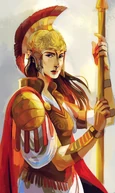
In Percy Jackson's Greek Gods, Athena is described as wearing elegant flowing gray robes, Greek battle armor, and an Imperial Golden helmet on her head, which is decorated with pictures of gryphons and sphinxes. In Percy Jackson's Greek Heroes, Athena wears a long white sleeveless clothes, and held a spear and rectangular shield in her easily, with both items "glowing with magic."
In Percy Jackson's Greek Heroes, Perseus described Athena's face is cute and regal merely also somewhat scary, the style a warrior goddess should look. Unlike any boring grey item on the Grayness Sisters island, her stormy greyness eyes are bright and "full of vehement energy." Percy also realized through her startlingly, common cold grey stare that she would make a terrible enemy. He immediately recognized the brunette goddess as Annabeth'south female parent, to the extent where he almost addressed Athena as her daughter. Athena was viewed to exist one of the virtually beautiful goddesses of all, given how she was perfectly capable of attracting male attending, but she employs her powers to do horrible things to them if they don't exit on her starting time warning.
Minerva
- Main article: Minerva
Athena tin can change into her Roman counterpart of Minerva. Unlike the other gods, she is less warlike and militaristic, being instead a goddess of crafts and wisdom.[1] Because the Romans depicted Minerva as a more than cerebral and demure goddess, she dislikes the Romans despite existence a Roman god, as they took abroad all her armed forces importance and stole her statue. Minerva remains a virgin goddess in this form, only refrains from having whatever children at all, unlike Athena who is able to take "Brain Children."
Abilities
Athena is known to be one of the most powerful daughters of Zeus, hence existence an extremely powerful goddess. Due to her considerable influence, she bears a greater level of worship than nearly of the Olympians, which contributes to her powers profoundly. The only gods who surpass her are the 6 oldest Olympians (the Big Three, Hera, Demeter, and Hestia). She is rivaled by both Apollo and Artemis.
- Divine Wisdom: As the Goddess of Wisdom, Athena is extremely wise, intelligent, and knowledgeable, constantly coming upward with brilliant ideas. She tends to measure the odds without taking her own or others' feelings into business relationship, leading to her voting to destroy Percy in The Titan's Curse (just she was outvoted). During the creation of Pandora in Percy Jackson's Greek Gods, Athena gifted the daughter with cleverness and marvel. She taught the Greeks numerous skills, such equally mathematics and utilizing the oxen to plough their fields. Due to her wisdom, Zeus trusted her to bank check on the imprisoned Titans in Tartarus.
- Strategic Skill: As the Goddess of Strategy, Athena is an exceptionally skilled tactician with great observation skills and superb capacity for planning for the long term earlier acting. Unlike Ares, she only uses violence equally a last resort afterward thinking things through. Percy noted that Athena wouldn't make a fault considering she hated her target or held emotional opinions - if she made a program to destroy an enemy, that programme would never fail. Zeus admires Athena's incredible tactical skills since he wouldn't let her exit the battle with Typhon considering she was his best strategist. She was able to see that Typhon was only a decoy in Kronos' plan to defeat the gods. Forth with her daughter, she made numerous battle plans of various lethal degrees in The Last Olympian.
- Adroitness: As the Goddess of Crafts, Athena is an incredibly practiced craftswoman. Every bit shown in Percy Jackson's Greek Gods, she was responsible for teaching Pandora crafts. As shown in Percy Jackson'southward Greek Heroes, Athena helped Jason by drawing up blueprints for the Argo and carved its magical prow herself. She later created the Mark of Athena coin, which guides her demigod children to the Athena Parthenos.
- Inventions: While non quite as good at inventing things as Hephaestus and her half-brothers Hermes, Athena realized many notable inventions. In Percy Jackson's Greek Gods, she invented the bridle to enable men to tame horses and the first flute, which played beautifully for being filled with her divine breath that enabled Marsyas to temporarily agree his ain in musical competition with Apollo. She notably designed and congenital the starting time chariot. Before the events of The Titan'south Curse, she created 2 angelic automatons as a gift to her begetter.
- Weaving: Athena is all-time known for her talent in weaving, the very art she invented. In the Olympian riot in Percy Jackson's Greek Gods, she fabricated magical ropes capable of restraining Zeus himself, to the point he needed help from the Hekatonkheire Briares. During her competition with Arachne, Athena wove a flawless tapestry that was "majestic, scenic, and radiated the power of the Olympian gods", though the contest ended in a match.
- Audiokinesis: Being a goddess of the arts, she has an analogousness for arts and music, though not quite on par with that of her half-brother Apollo.
- Persuasion: Athena is shown to exist very eloquent, every bit she could manipulate other gods. She fifty-fifty avoided penalty from the Olympus Anarchism through talking with Zeus.
- Memorization: She tin never forget what she hears.
- Prowess in Battle: As the Goddess of Warfare, Athena is a superb warrior and a complete principal of both armed and hand-to-manus combat, but frequently uses her wisdom to overcome her opponents instead of sheer strength. Every bit revealed in Percy Jackson'south Greek Gods, she learned all of her great gainsay skills from the nymphs of Lake Tritonis. She and Pallas would often engage in sparring matches, which were described every bit and then intense that Zeus finally intervened. During the Trojan State of war, Athena managed to defeat Ares singlehandely and force him to abscond the battlefield. She was able to defeat the fire-breathing Enceladus (the most cunning Giant) twice, with the help of Hercules and later Annabeth in The Claret of Olympus. In particular, Percy speculated that she would brand an enemy x times worse than Dionysus (dangerous when angry to breaking point) and rivals in battle to Poseidon (one of the three mightiest Olympians).
- Telumkinesis: As the Goddess of Warfare, Athena has slap-up control over any weapon, much like Ares.
- Weapon Conjuration: She can conjure any weapon, though she prefers to use her spear and Aegis.
- Weapon Curses: She tin place curses on weapons.
- Weapon Omniscience: She knows everything nigh a weapon when she sees it.
- Disarmament: She can disarm her opponents with a gesture.
- Mystiokinesis (limited): Athena has control over magic, though not every bit much as Hecate. She infused her power on the Athena Parthenos statue (which acts as an incredible bulwark) and enchanted a Yankees cap with the power of invisibility.
- Granting Custodianship Portions: As shown in Percy Jackson's Greek Heroes and The Blood of Olympus, Athena can imbues the cloaks of her chosen heroes with the invulnerability of her own Aegis cloak, which glitters with power.
- Chlorokinesis (express): Though not as powerful as her aunt Demeter and her one-half-brother Dionysus, Athena has a degree of control over flora. She tin can influence the growth of certain plants, such as olive trees.
- Teleportation: She transported Annabeth'southward books out of her bag to supervene upon them with her Yankees cap along with a square of ambrosia.
- Parthenogenesis: Athena can conceive children when her divine thoughts meet the mortal ingenuity of the men. Her children are born in the same way she was, literally making them "brainchildren". It is believed that this power was influenced by the fact she came out of Zeus' encephalon.
- Life Creation: Athena has demonstrated the ability to manipulate reality itself to a considerable extent. She conjured up a magical serpent, which was intended to heighten the godly qualities of her son Erikhthonios in Percy Jackson'southward Greek Gods.
- Curses: Athena can place horrible curses on objects and people. As seen in Percy Jackson's Greek Gods, she cursed a flute to give the worst fortune to the next person to play it, which ended up with the satyr Marsyas getting flayed alive by Apollo. She later cursed Teiresias with permanent incomprehension. In the Trojan State of war, she cursed Ajax the Bottom with madness. As shown in The Battle of the Labyrinth, she cursed her son Daedalus with a scarlet partridge-shaped mark that would never fade and to live a long, tortured life.
- Transfiguration: Athena is very gifted in the power of transfiguration. Every bit shown in Percy Jackson's Greek Gods, she transformed Medusa, Euryale, and Stheno into the commencement Gorgons, Coronis into the commencement raven, Arachne into the get-go spider, and Perdix into a partridge.
- Shapeshifting: Equally a goddess, Athena has the power of shapeshifting, in which she proved to be very skilled. Equally shown in Percy Jackson's Greek Gods, she could transform herself into pure intelligence in lodge to travel from Zeus' tummy into his head, a skill she had learned from her mother. When she first approached Arachne, she transformed herself into an elderly woman. In The Titan's Curse, she appeared as a park ranger at the Hoover Dam. In The Last Olympian, she took the guise of an owl.
- Control of Animals: Athena appears to take a high level of control over animals sacred to her, such as owls and serpents. As seen in Percy Jackson's Greek Gods, she would afterward have birds and snakes follow and lead Teiresias, while also granting him the power to understand their speech.
Attributes
- Her attributes are her spear, the armor, the helmets, the olive tree, the Aegis and the Gorgoneion.
- Her sacred animals are the owl and serpent, which represent the wisdom of the sky and globe, respectively.
- Athena is the patron goddess of Athens, which was named after her.
Gifts
Athena has shown to exist the most active goddess, secretly protecting her children from monsters and giving gifts to heroes who earn her admiration.
- She gave pieces of Aegis to several of her chosen heroes in the past.
- She gave her son Daedalus and her grandson Perdix her blessing of wisdom.
- She gave her daughter Annabeth a protection from monsters when she ran away until meeting Thalia and Luke, a cap of invisibility (though it lost its power in The Marker of Athena when her Roman form and Annabeth argued, simply later restores it in a moment of need in the Staff of Serapis), and a square of ambrosia.
- She granted Reyna pieces of Aegis to aid her in the battle with Orina and let her strength along with Bellona.
Family unit

Annabeth Chase, her favorite child
Although she is a virgin goddess, Athena can conceive demigod children by joining her listen with her mortal lovers, which she considers to be the purest kind of beloved that one could give upon. Her demigod children are "gifts" to the men she favors. She loves all of her children and is actually the just known deity who claims demigods at nascence. She oft gives gifts to their children for their quests and protects them when they need help. Athena considers Annabeth Chase her greatest pride and joy. She deeply trusts her daughter, to the point they make strategies together in times of crisis. Since her daughter's loyalty for Percy is unwavering, she reluctantly accepted their love relationship together.
Mortal Children
| Partner | Children |
| Hephaestus | Erichthonius of Athens |
| Metion | Daedalus, Eupalamus, Sicyon |
| Augustine Washington | George Washington |
| Jean Bartholdi | Frederic Bartholdi |
| Bea'south Parent | Bea Wise |
| Frederick Hunt | Annabeth Chase |
| Malcolm's Parent | Malcolm Pace |
| Zane's Parent | Zane Carver |
Relationships
Gods

Zeus, her father.
Athena is Zeus' favorite girl due to her strategic, fair nature. He defended her against the other gods and those he accounted as lethal opponents. While she frequently helps her father in several emergencies, she was part of a riot confronting him because of her dislike towards his dictatorial actions.

Artemis, her half-sis and fellow virgin goddess.
Athena has a decent familial relationship with her one-half-sister Artemis, every bit the 2 of them share somewhat similar personalities. The ii virgin goddesses often have conversations after meetings.

Poseidon, her uncle and rival.
Despite ofttimes having similar decisions and oftentimes sharing sides in times of war, Athena has a biting rivalry with her uncle Poseidon. Their human relationship seems to be the basis of her dislike for Percy Jackson, Poseidon'southward son, and the goddess does not corroborate of his love for her girl. Although she has told him to stay away from Annabeth on several occasions, she seems to be more civil towards Percy at the end of the series.

Ares, a fellow Olympian and her half-brother.
Despite both deities existence associated with state of war, Athena doesn't have a practiced human relationship with her half-brother Ares. She considers his violent and encarmine version of combat tasteless, which opposes her intentions of winning with every bit few deaths equally possible.

Aphrodite, a young man Olympian.
Athena didn't go forth well with Aphrodite, for her serious and dignified nature acquired her to notice the goddess of lust somewhat shallow and conceited.
Flick
The Lightning Thief
Athena is played by Melina Kanakaredes. She played a more major function than the other gods at Olympus, as well Zeus and Poseidon. She was seen talking to Zeus well-nigh the threat of war between the gods if Master Bolt is not returned, trying to convince him that 'war is not the answer.' When peace is alleged past Zeus, Annabeth says 'Hi, mom,' and Athena tells her that she is very proud of her.
While they were in the Parthenon, Percy sees 'Athena' written in Greek at the foot of her statue, and when he tells Annabeth, she wonders whether her mom actually looks like the statue. Percy, in response, tells her 'We'll find out,' indicating that he is confident they will survive the quest and make information technology to Olympus.
Annabeth likewise mentions that her female parent had been speaking to her telepathically to help her, similar to how Poseidon spoke to Percy, saying that fifty-fifty though she had non seen her, she still felt close to her mother.
The picture show version of Athena is less strict and did not show any sign of not liking Poseidon or Percy (even though Annabeth claimed that their parents "hate each other"). She even states that "War is not the respond," This is perhaps a little paradoxical, every bit she is a goddess of state of war. However being the goddess of strategy, she knew that a war betwixt the gods was not the answer and would only lead to unneeded cede.
Gallery

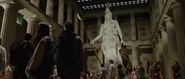
Athena statue in the Parthenon in Nashville
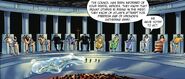

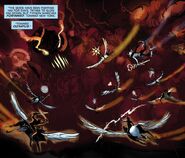
Trivia
- Similar many of her Olympian siblings, her name starts with an A.
- Despite her existence said to take gray eyes and black hair, her official portrait shows her with brown eyes and brown hair with red highlight.
- The first letter of her name 'A' is the same as the first alphabetic character in her daughter's proper noun.
- When she leads in battle, Athena was known as "Athena Promachos."
- She besides is a patron of Sparta, where she was called "Athena Poliachos, pregnant "Athena Protector of the Urban center."
- Athena was known every bit "Athena Parthenos" ("Athena the Virgin"), which was how she was worshiped at the Athenian Parthenon. This would also be the proper name of her statue that stood there, which eventually becoming the most famous Greek statue of all time.
- In some Greek myths, Athena was a goddess of magic.
- According to Greek mythology, Zeus trusted Athena to wield his thunderbolt.
- According to Aphrodite, Athena is the virtually Greek among the goddesses.
- According to Homer's account in the Iliad, Athena was a fierce and ruthless warrior and she is portrayed in the Odyssey as angry and unforgiving. However, according to some sources, Athena was praised for her compassion and generosity.
- Athena is one of only three current Olympians goddesses who is a virgin, the others being Artemis and Hestia.
- She is also the merely Greek Virgin goddess who has children.
- In Greek mythology, the goddess Athena never had whatever children. Erikhthonios was her adopted child.
- Athena's most of import festival was the Panathenaea, which was celebrated annually at Athens.
- In the serial, Frederic Bartholdi designed The Statue of Liberty as a representation of his mother.
- Pallas, ane of the largest asteroids in the asteroid belt, is named after Pallas Athene Parthenos, one of Athena'due south alternative names.
- Minerva, her Roman counterpart, is displayed on the Medal of Award, the highest military decoration awarded by the United States government.
- She also appears on the state seal of California, because she was born an adult, and California was never a territory.
- Her Norse equivalent would exist Freyja or Nerthus.
- Her Egyptian equivalents (in terms of attributes) are Seshat, Isis, Thoth, and Neith.
Citations
- ↑ The Mark of Athena, page 32
| Percy Jackson and the Olympians | |
| Core Series: | The Lightning Thief | The Sea of Monsters | The Titan's Curse | The Battle of the Labyrinth | The Last Olympian |
| Main Characters: | Percy Jackson | Grover Underwood | Annabeth Chase | Tyson | Clarisse La Rue | Thalia Grace | Nico di Angelo | Chiron | Luke Castellan | Rachel Elizabeth Dare |
| Secondary Characters: | Sally Jackson | Travis Stoll | Connor Stoll | Mrs. O'Leary | Silena Beauregard | Charles Beckendorf | Paul Blofis | Blackjack | Zoë Nightshade | Bianca di Angelo | Juniper | Ethan Nakamura |
| Pocket-size Characters: | Gabe Ugliano | Frederick Chase | Michael Yew | May Castellan | Austin Lake | Kayla Knowles | Maria di Angelo | Will Solace |
| Olympian Gods: | Zeus | Hera | Poseidon | Demeter | Ares | Athena | Apollo | Artemis | Hephaestus | Aphrodite | Hermes | Dionysus | Hades | Hestia |
| Pocket-size Gods: | Amphitrite | Ariadne | Hecate | Iris | Janus | Morpheus | Nemesis | Pan | Persephone | Triton |
| Titans: | Kronos | Atlas | Calypso | Iapetus | Krios | Hyperion | Oceanus | Prometheus |
| Related Content: | Rick Riordan | The Lightning Thief (film) | Ocean of Monsters (film) | The Demigod Files | Demigods and Monsters | The Ultimate Guide | The Heroes of Olympus | The Trials of Apollo | Disney+ Series |
| The Heroes of Olympus | |
| Core Series: | The Lost Hero | The Son of Neptune | The Mark of Athena | The House of Hades | The Blood of Olympus |
| Main Characters: | Jason Grace | Piper McLean | Leo Valdez | Percy Jackson | Frank Zhang | Hazel Levesque | Annabeth Chase | Reyna Ramírez-Arellano | Nico di Angelo | Gleeson Hedge |
| Secondary Characters: | Hylla Ramírez-Arellano | Dakota | Tyson | Ella | Octavian | Halcyon Green | Dr. Howard Claymore | Alabaster C. Torrington | Lamia | Iapetus/Bob |
| Small-scale Characters: | Rachel Elizabeth Dare | Grover Underwood | Thalia Grace | Fleecy | Mrs. O'Leary | Kinzie | Arion | Calypso | Lou Ellen Blackstone | Chiron | Will Solace | Tristan McLean | Don | Julia | Jacob | Michael Varus | Burly Black | Medea | Midas | Lityerses | Phineas | Otrera | Echo | Narcissus | Sciron | Pasiphaë |
| Olympian Gods: | Zeus | Hera | Poseidon | Hades | Ares | Demeter | Athena | Apollo | Artemis | Hephaestus | Aphrodite | Hermes | Dionysus |
| Minor Gods: | Achelous | Aeolus | Asclepius | Boreas | Eurus | Hecate | Iris | Hypnos | Keto | Khione | Kymopoleia | Mithras | Nemesis | Nike | Notus | Phorcys | Serapis | Thanatos | Triptolemus | Zephyros |
| Roman Gods: | Jupiter | Juno | Neptune | Pluto | Mars | Minerva | Ceres | Lupa | Bellona | Fortuna | Janus | Terminus | Vulcan | Mercury | Apollo (Roman) | Diana | Venus | Bacchus | Pomona | Aquilon | Hercules | Cupid | Auster | Favonius | Letus | Victoria |
| Giants: | Enceladus | Porphyrion | Alcyoneus | Polybotes | Ephialtes | Otis | Damasen | Clytius | Mimas | Orion | Hippolytos| Thoon | Periboia |
| Undead: | Grey |
| Primordial Gods: | Gaea | Tartarus | Ourae | Nyx | Anarchy | Ouranos | Akhlys | Hemera | Elpis | Spes |
| Monsters and Magical Creatures: | Cynocephali | Gorgon | Gryphon | Harpy | Basilisk | Lycanthrope | Gegeines | Cyclops | Katobleps | Unicorn | Giant Eagle | Ichthyocentaur | Satyr/Faun | Storm Spirit | Laistrygonian Giant | Lares |
| Related Content: | Rick Riordan | Haley Riordan | Percy Jackson and the Olympians | Percy Jackson and the Olympians: The Ultimate Guide | The Demigod Files | The Demigod Diaries | The Son of Sobek | The Singer of Apollo | The Staff of Serapis | Percy Jackson'due south Greek Gods | Percy Jackson's Greek Heroes | The Crown of Ptolemy | Demigods & Magicians | Demigods of Olympus | Percy Jackson Demigod Collection |
Source: https://riordan.fandom.com/wiki/Athena
0 Response to "How You Know Athena Wisdom in the Odyssey"
Enregistrer un commentaire